Adam Brami outlines the reasons why he believes we are seeing the quiet emergence of a different model of work.
As the new year gets underway, I find myself reflecting on the future of white-collar work in New Zealand. Over the summer break, I saw friends and colleagues who had been made redundant – or knew their roles were under threat – starting this year by reassessing what “work” will look like for them next.
At the same time, the businesses I work with are facing a reckoning of their own: They’re under intense pressure to cut costs and protect margins to stay competitive, yet they can’t compromise the quality of what they deliver to clients.
These two forces – dislocated workers and squeezed companies – are now colliding. And from that collision, we’re witnessing the quiet emergence of a very different model of work.
The return-to-the-CBD narrative
In Auckland, with the City Rail Link nearing completion, I’m hearing a familiar narrative: that improved transport access will draw workers back into the central city and somehow restore office life to its old normal. But to me, this framing avoids a more fundamental question – not whether we can bring people back to the office more easily, but why we should.
According to mid-2025 data from Colliers and JLL, overall CBD office vacancies in New Zealand remain well above pre-pandemic levels. While a narrow band of premium, amenity-rich office space is still in demand – with Auckland’s five major towers sitting at just 2.1% vacancy (Colliers, June 2025) – broader availability paints a different picture.
In Auckland, total CBD office vacancy stood at 16.5% (JLL, H1 2025), a figure roughly triple its pre-2020 baseline. Wellington followed with 13.8% vacancy (JLL, Q2 2025), while Christchurch saw its CBD vacancy spike from 3.7% to 8.4% after a major refurbished building returned to market (Colliers, May 2025).
None of this suggests a workforce waiting for infrastructure to catch up. It points instead to businesses that have already resized, rethought, or rejected the assumption that work must be anchored to a single physical location.
Yes, better transport can change commuting patterns. But it doesn’t, by itself, restore the logic of co-location.
For decades, I too assumed that an office was a prerequisite for collaborating and doing serious work. But that assumption is now being tested – not for ideological reasons, but for economic and operational ones.
In many professional services firms, the question has already shifted from “How do we get people back into the office?” to something more fundamental: What value does working under the same physical roof truly create for our clients, and is that value strong enough to justify the cost?
If being co-located clearly leads to better thinking, sharper collaboration, faster decision-making and stronger outcomes, then the office deserves its place. But if its primary function is managerial convenience, cultural habit, or legacy expectation, it becomes hard to defend.
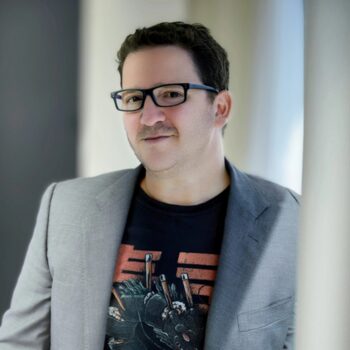
Adam Brami
Consider the numbers. For an 80 to 100 person professional services firm, keeping a CBD office can easily mean paying tens of thousands of dollars each month in rent alone, often upwards of $50,000, for quality space. Add the costs of fit-outs, maintenance, utilities, dedicated support staff, and long-term lease commitments in an uncertain market, and the expense escalates quickly.
The hidden constraint
This is where I’ve seen the office impose a quieter – but no less consequential – influence. Once work is tied to a single physical location, your talent pool shrinks to those within commuting distance. In practice, that means organisations often end up assembling not the best possible team for a given problem, but simply the best team available nearby.
These days, many of the most experienced specialists in their fields are either choosing – or have been forced – to work independently or in fractional roles. In that environment, a fixed office footprint can turn into a liability rather than an advantage. I’ve watched senior practitioners opt out of full-time, location-bound roles in favour of project-based work where they can deploy their expertise exactly where it’s needed. And the demand for that kind of specialist input is growing, especially among businesses that want targeted impact.
Why the collective model changes the equation
This is exactly why I believe the collective model is changing the equation – not as a trendy lifestyle choice, but as a structural response to the mismatches above. The team is built around the problem first, then assembled from a network of senior specialists best suited to solve it.
We’re seeing this approach gain traction across marketing and creative services, consulting, accounting, legal services, technology, design, and digital delivery.
From the client’s perspective, the appeal is obvious. They get access to senior expertise on demand, without carrying the overhead of permanent teams or paying for capabilities they don’t actually need. The work is shaped around the problem – not around an organisational chart.
Technology removed the last excuse
One understated legacy of the Covid era is just how mature distributed work has become. Modern collaboration platforms, real-time project management tools, and even AI now act as a coordination layer – they’ve removed many of the historical advantages that once came from having everyone in the same place. I can plan, execute, review and refine complex projects with team members spread across multiple cities (or countries), often with greater clarity and accountability than we ever had when all sitting in one office.
Collaboration isn’t dictated by proximity anymore; it’s dictated by intent. And once an organisation experiences this kind of effectiveness without relying on shared physical space, the office stops being a necessity and becomes a choice.
A structural shift, not a temporary phase
In my view, this isn’t a short-term correction or a post-pandemic blip – it’s a deeper realignment in how professional services are structured and delivered. With each redundancy cycle, more senior talent gets displaced from the traditional firm model.
Collective and fractional models are increasingly filling that gap. A growing number of lean, senior-led businesses are deliberately avoiding fixed offices and permanent payrolls, instead pulling in specialist expertise around clearly defined client problems on an as-needed basis.
One example of this shift is the business I lead, Art of the Possible, a marketing services collective operating across New Zealand and Australia. Rather than maintaining a central office or permanent in-house teams, we draw from a distributed pool of senior specialists in both markets, assembling blended teams based on relevance and experience rather than geography.
We don’t think in terms of separate New Zealand or Australian divisions – just the best mix of specialist experience for the problem in front of them at any given time.
Increasingly, the idea of the collective is extending beyond the boundaries of a single business model. What I’m seeing more often is a wider, informal alignment between like-minded operators across disciplines – marketing referring into legal, legal into accounting, accounting into IT.
These aren’t conglomerates or bundled service providers, but independent businesses choosing to collaborate where their capabilities are complementary and non-competing. It’s a distributed network of mutual referrals built on trust, shared standards, and a common mindset – where value is passed not just within teams, but between them. For the client, the benefit is seamlessness without mark-up. For the businesses involved, it’s a way to broaden relevance without diluting focus.
And it’s not just marketing adopting a new way of working. One accountancy firm has been a fully online firm from day one and another legal firm operates with lawyers working remotely.
To me, models like these reflect a broader shift in client expectations. More businesses are less concerned with offices and more focused on outcomes, tangible progress on real commercial problems, delivered by people with relevant experience.
Adam Brami is the director ANZ of the Art of the Possible Agency.