
Despite near universal optimism in the rural sector, a panel of New Zealand’s leading food and agri minds say the sector must be intentional about its future path if it’s to successfully navigate the social, economic, environmental and technological forces impacting its operating environment.
The latest version of Rabobank’s annual white paper ‘Succession 2050 – gearing up for New Zealand’s food and agri future’ focuses on the topic of succession at an industry level.
Rabobank says in a statement that in addition to its own insights, the paper brings together a selection of 14 leading New Zealand and international food and agri experts – including trade negotiators, economists, systems analysts, scientists and technologists along with sectoral experts in sustainability, the future of fibre and Māori enterprise – to share their perspectives on what the New Zealand food and agri sector could look like in 2050 and what needs to change to achieve that vision.
Launching the new paper at the Primary Industries New Zealand Summit in Auckland Rabobank New Zealand CEO Todd Charteris said the experts who contributed to the white paper had identified plenty of reasons for New Zealand to be confident about its food and agri future.
“We’re a major food producer in a food-hungry world that’s on track to need 56% more food by 2050…
“To name just a few, we’re a major food producer in a food-hungry world that’s on track to need 56% more food by 2050,” he said.
“Our food and fibre exports are also growing strongly and are forecast to hit $64.3 billion for the year to June 2026, while our government has signalled its plans to help double overall New Zealand exports by 2034.”
While there were many reasons for optimism, Charteris said, the expert contributors had also noted a host of changes taking place across the global food and agri operating environment that would need to be navigated for the industry to achieve ongoing success in the decades ahead.
“A number of key changes shaping the future of the sector came through in the perspectives of the expert contributors.
“There are the well-canvased issues of increasing global food insecurity, the challenging trade environment driven by geopolitical tensions, and the need to produce food within planetary limits.
“The experts also raised emerging trends, including what we’ve called ‘Identity eating’…
“However the experts also raised emerging trends, including what we’ve called ‘Identity eating’ – which is the growing way of signalling who you are as a person through what you eat – and is leading to higher demand for ethical and health-conscious foods.
“Another key trend identified out to 2050 was ‘Exponential everything’, which covers the transformation of the sector through science and technology.”
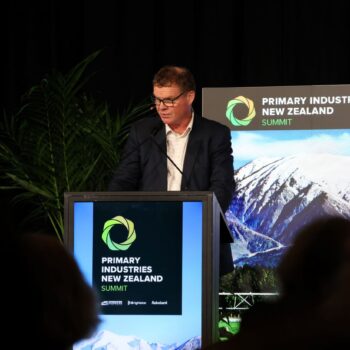
Todd Charteris presenting at the summit. Image courtesy of Rabobank.
Rather than let these changes wash over it like a tsunami, Charteris said, the broadly held view among the expert contributors was that New Zealand’s agriculture sector would need to lean in and proactively shape the changes occurring around it.
“We heard this message in many different ways; whether it was influencing global trade policy, embracing technology, capitalising on sustainability, training up for the future, defending our advantage in dairy or kiwifruit, growing Māori enterprise or more deliberately utilising all the wealth in our big blue backyard,” he said.
Building a 2050 growth engine for food and agri
Charteris said the white paper contributors had identified 23 changes they would like to see in New Zealand between now and 2050 that will help set up the sector for success.
“Essentially, they boil down into five buckets with four to five ‘work ons’ in each bucket. At the centre, we need a change model that starts from the customer perspective and works outward from that, feeding into more purposeful decisions about land use and production systems.
“Then once we are clear on what customers are asking for and where we want to play, we need to stack talent and technology. Between these items we have the elements of a 2050 growth engine.”
What’s exciting, Charteris said, is that New Zealand has the geography, the capacity, the ideas and the time, to make something outstanding of its future.
“My wish is that our experts’ thinking will inspire others to join me in pushing for a more deliberative strategic future for New Zealand.”
Land-Use Flexibility Package
Charteris said the Government’s recently announced Land-Use Flexibility Package was an example of the type of strategic approach required across the sector.
“This new package is expected to provide the credibility and confidence required to grow the agricultural sector responsibly, as well as strengthen New Zealand’s position as a world leader in sustainable food produce,” he said.
Charteris said Rabobank was one of the industry partners backing the Responsible Dairy programme – one of the initiatives sitting under the wider Government package.
“The goal of the Responsible Dairy programme is to strengthen resilience and value by lifting farmers to higher levels of productivity, efficiency and sustainability, while continuing to drive environmental gains across the sector.”
The programme has some ambitious targets for the sector including a 20% lift in milk solids and a 20% reduction in nitrogen leaching per hectare by 2050, and we’re really proud to back this important new initiative.”
The full Rabobank white paper can be accessed here.
Main story photo by Ivan Theodoulou on Unsplash