Rising living costs, economic uncertainty and rapid technological change are reshaping how New Zealanders think, spend and live, a recent report has found.
The 2025/26 New Zealand Consumer Lifestyles Study from the University of Otago – Ōtākou Whakaihu Waka is the eighth study in a series dating back to 1979, allowing researchers to examine how New Zealand consumers and their lifestyles are changing over time.
Overall, the researchers conclude that the New Zealand consumer landscape has become more fragmented since 2020. The large lifestyle groupings evident five years ago have become smaller and more differentiated, while the proportion of economically constrained consumers has increased substantially.
They say that for businesses, policymakers and community organisations, the findings highlight the limitations of thinking about a single “New Zealand consumer”.
Lead researcher Associate Professor Leah Watkins says in a statement that New Zealanders “are navigating many of the same economic, social and technological changes, but they are responding to them in very different ways”.

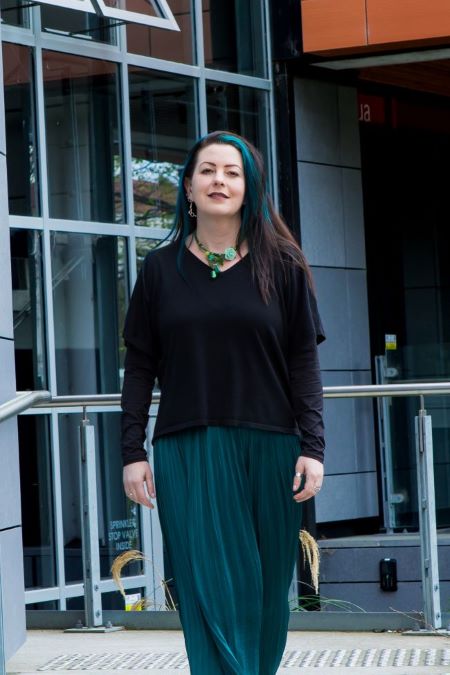
Associate Professor Leah Watkins.
“Understanding those differences — in people’s financial circumstances, values, priorities and ways of living — is increasingly important for organisations seeking to understand and serve New Zealand consumers.”
Conducted by researchers in the Department of Marketing at Otago Business School, the latest report surveyed 1,096 New Zealand adults on approximately 360 questions about their attitudes, values, lifestyles and consumption behaviours.
The impact of sustained cost-of-living pressure
The researchers say one of the clearest findings is the impact of sustained cost-of-living pressure.
Almost half of respondents (48 percent) said economic uncertainty had prevented them from making purchases they would otherwise make, compared with 30 percent in 2020.
Forty percent reported struggling to pay for essentials, while 52 percent had gone without something they would normally buy in order to meet essential costs. The proportion saying they usually choose the lowest-priced product rose from 45 percent in 2020 to 57 percent in 2025.
Watkins says that the findings show that economic pressure is influencing not only what people buy, but how they feel about their lives and the future.
“The 2025/26 results reveal a New Zealand consumer who is considerably more cautious about money and the economic outlook than five years ago.
Quality, durability, local purchasing and responsible consumption continue to matter…
“Price and value have become increasingly important, but consumers are not simply looking for the cheapest option. Quality, durability, local purchasing and responsible consumption continue to matter,” she says.
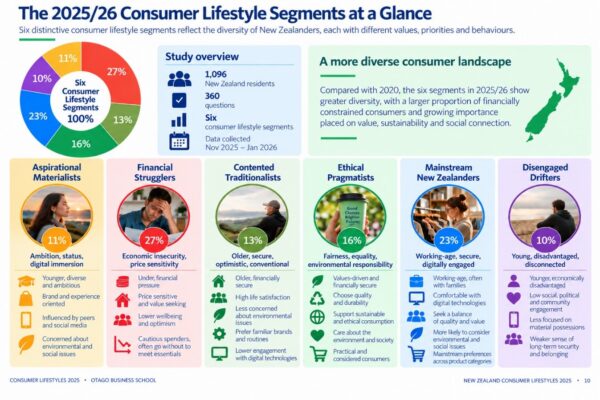
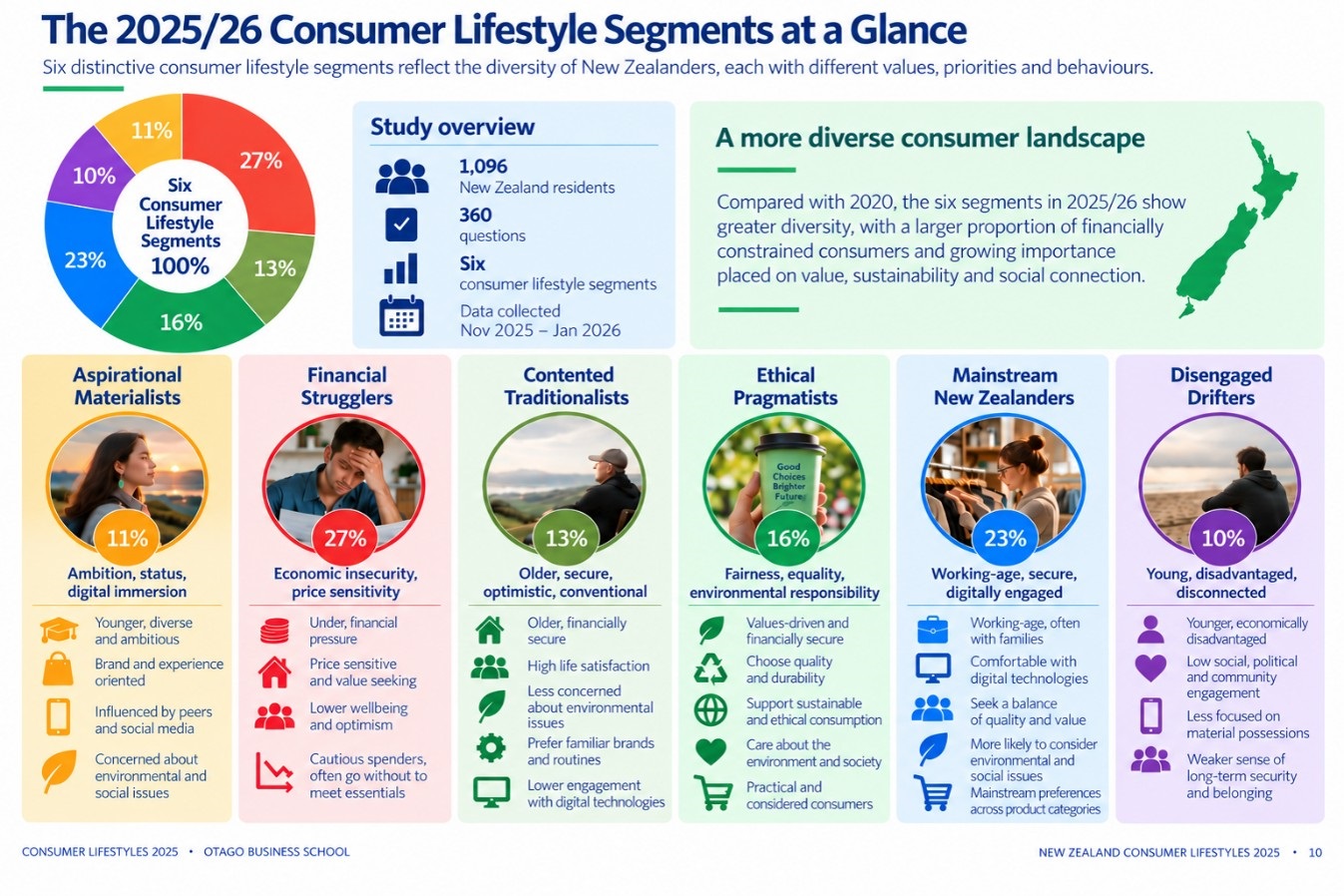
The changing economic environment is also reflected in the six consumer lifestyle groups identified by the research.
The group titled ‘Financial Strugglers’ now account for 27 percent of New Zealand adults, compared with 16.5 percent for the comparable segment in 2020.
This group is characterised by financial insecurity, strong price sensitivity and relatively low optimism about both personal circumstances and the direction of the country.
Six portraits of contemporary New Zealand consumers
The research identifies six distinctive consumer groups: Aspirational Materialists (11 percent), Financial Strugglers (27 percent), Contented Traditionalists (13 percent), Ethical Pragmatists (16 percent), Contemporary Mainstream (23 percent), and Disengaged Drifters (10 percent).
Watkins says the segments reveal substantial differences in financial circumstances, values, wellbeing, environmental concern, material aspirations and engagement with technology.
“At one end are younger, digitally immersed Aspirational Materialists, who combine strong ambitions for achievement and status with concern about environmental and social issues.
“At the other end are older Contented Traditionalists, who report particularly high life satisfaction and financial security but relatively low engagement with environmental issues and newer digital technologies.”
Ethical Pragmatists, meanwhile, represent a mature, financially secure and values-driven group whose consumption decisions emphasise quality, durability, repair, reuse, environmental sustainability and responsible business practices, she says.
Digital life is mainstream — but influence does not necessarily follow
The study also captures the continuing transformation of New Zealanders’ media lives. Traditional print consumption has fallen sharply: newspaper readership declined from 45 percent in 2020 to 30 percent in 2025, while magazine readership dropped from 29 percent to 17 percent.
Online shopping, social media, streaming and digital communication are now embedded in everyday life, but the findings challenge assumptions about the power of digital marketing.
For businesses, simply increasing the volume of digital communication is unlikely to substitute for delivering genuine value and positive customer experiences…
Friends and family remain the most influential source of consumer information, with 59 percent rating their recommendations as important or very important.
In contrast, 71 percent regarded celebrity endorsements as having limited influence and 65 percent said the same of social media influencers. More than half (55 percent) reported that AI assistants had little or no influence on their consumption decisions.
“Consumers may be spending much more of their lives online, but that doesn’t mean every digital message is persuasive,” Watkins says.
“Interpersonal trust remains extremely important. For businesses, simply increasing the volume of digital communication is unlikely to substitute for delivering genuine value and positive customer experiences.”
Frugal, but still concerned about sustainability
Despite financial pressures, the research suggests New Zealanders continue to place value on responsible consumption.
It shows 85 percent agreed that taking good care of possessions can save money in the long run, 84 percent saw little sense in buying something new when an existing item could be reused, and 82 percent said they were careful about how they spend their money.
Sustainability increasingly overlaps with these practical concerns. Reuse, repair, reducing waste and resource conservation are prominent behaviours, while 52 percent said buying from locally owned and operated New Zealand businesses was important to them.
“The relationship between affordability and sustainability is particularly interesting,” Watkins says.
“Behaviours such as buying durable products, repairing and reusing possessions, avoiding waste and purchasing thoughtfully can make sense both financially and environmentally.”
Click here to see the full report.
Source: University of Otago.